


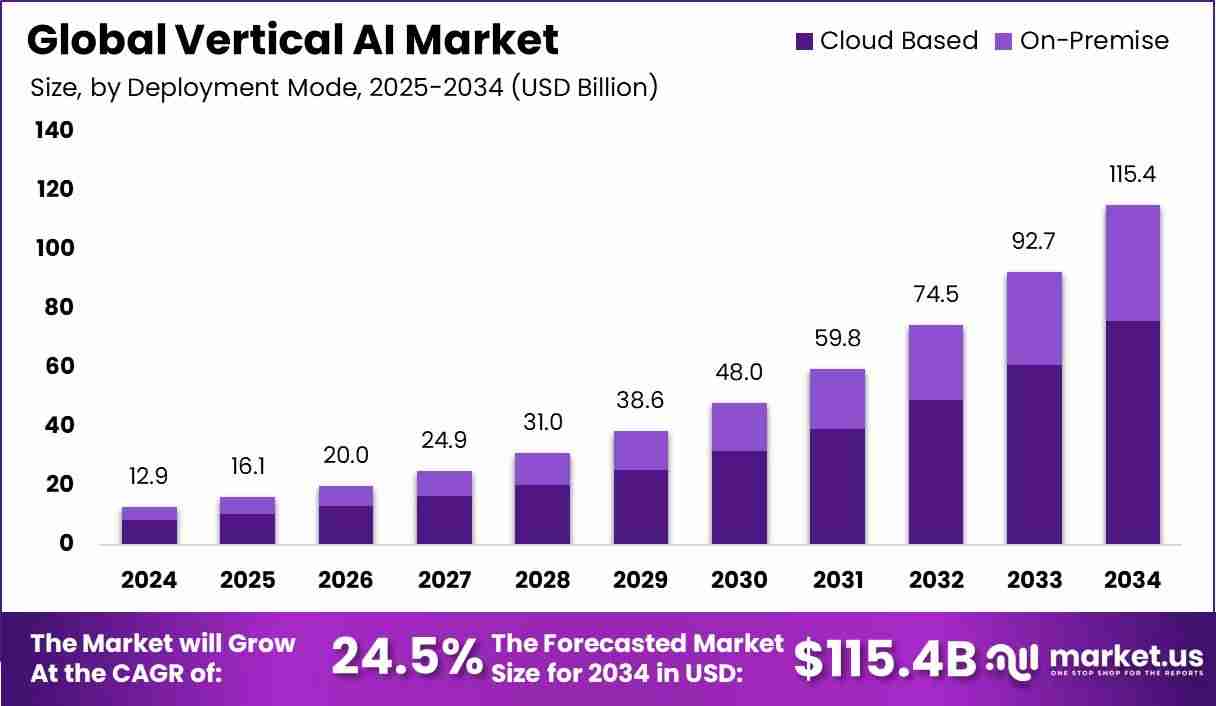
The conversation around Vertical AI vs Horizontal AI has become central to enterprise technology strategy as organizations seek artificial intelligence that delivers measurable business outcomes. While horizontal AI platforms aim to provide broad, reusable capabilities across industries, Vertical AI systems are designed with domain context, regulatory awareness, and sector-specific data intelligence. This distinction is shaping how enterprises invest in AI and how vendors position their solutions in the rapidly expanding Vertical AI Market.
Discover how the Vertical AI Market is accelerating industry-specific AI adoption across healthcare, finance, manufacturing, and retail with measurable ROI at: https://market.us/report/vertical-ai-market/.
Observations from AI deployments in insurance provide a practical lens for understanding this divide. Domain-trained models significantly enhance underwriting precision, accelerate claims processing, and strengthen fraud detection. These results highlight why industry-specific AI is gaining preference over generalized approaches across healthcare, finance, manufacturing, and retail.
Horizontal AI refers to platforms and models built for wide applicability. These systems offer flexibility and scalability, making them suitable for experimentation and generic automation tasks. However, they often lack the contextual intelligence required to operate effectively in complex industry environments.
In regulated sectors, horizontal AI struggles with compliance alignment, domain terminology, and specialized data formats. This limitation leads to extensive customization efforts before deployment. As a result, enterprises are shifting toward Vertical AI Solutions that are pre-aligned with industry requirements and capable of delivering faster, more accurate outcomes.
Vertical AI is characterized by deep domain training, contextual data understanding, and built-in compliance awareness. These systems are designed to interpret sector-specific datasets from the outset. In healthcare, they analyze medical images and patient histories. In finance and insurance, they evaluate risk variables and detect transactional anomalies. In manufacturing, they interpret sensor data for predictive insights.
This domain alignment makes Vertical AI Applications more effective for mission-critical tasks, reducing errors and improving operational reliability across industries.
Discover how the Vertical AI Market is accelerating industry-specific AI adoption across healthcare, finance, manufacturing, and retail with measurable ROI at: https://market.us/report/vertical-ai-market/.
Observations from AI deployments in insurance provide a practical lens for understanding this divide. Domain-trained models significantly enhance underwriting precision, accelerate claims processing, and strengthen fraud detection. These results highlight why industry-specific AI is gaining preference over generalized approaches across healthcare, finance, manufacturing, and retail.
Horizontal AI refers to platforms and models built for wide applicability. These systems offer flexibility and scalability, making them suitable for experimentation and generic automation tasks. However, they often lack the contextual intelligence required to operate effectively in complex industry environments.
In regulated sectors, horizontal AI struggles with compliance alignment, domain terminology, and specialized data formats. This limitation leads to extensive customization efforts before deployment. As a result, enterprises are shifting toward Vertical AI Solutions that are pre-aligned with industry requirements and capable of delivering faster, more accurate outcomes.
Vertical AI is characterized by deep domain training, contextual data understanding, and built-in compliance awareness. These systems are designed to interpret sector-specific datasets from the outset. In healthcare, they analyze medical images and patient histories. In finance and insurance, they evaluate risk variables and detect transactional anomalies. In manufacturing, they interpret sensor data for predictive insights.
This domain alignment makes Vertical AI Applications more effective for mission-critical tasks, reducing errors and improving operational reliability across industries.
The conversation around Vertical AI vs Horizontal AI has become central to enterprise technology strategy as organizations seek artificial intelligence that delivers measurable business outcomes. While horizontal AI platforms aim to provide broad, reusable capabilities across industries, Vertical AI systems are designed with domain context, regulatory awareness, and sector-specific data intelligence. This distinction is shaping how enterprises invest in AI and how vendors position their solutions in the rapidly expanding Vertical AI Market. Discover how the Vertical AI Market is accelerating industry-specific AI adoption across healthcare, finance, manufacturing, and retail with measurable ROI at: https://market.us/report/vertical-ai-market/. Observations from AI deployments in insurance provide a practical lens for understanding this divide. Domain-trained models significantly enhance underwriting precision, accelerate claims processing, and strengthen fraud detection. These results highlight why industry-specific AI is gaining preference over generalized approaches across healthcare, finance, manufacturing, and retail. Horizontal AI refers to platforms and models built for wide applicability. These systems offer flexibility and scalability, making them suitable for experimentation and generic automation tasks. However, they often lack the contextual intelligence required to operate effectively in complex industry environments. In regulated sectors, horizontal AI struggles with compliance alignment, domain terminology, and specialized data formats. This limitation leads to extensive customization efforts before deployment. As a result, enterprises are shifting toward Vertical AI Solutions that are pre-aligned with industry requirements and capable of delivering faster, more accurate outcomes. Vertical AI is characterized by deep domain training, contextual data understanding, and built-in compliance awareness. These systems are designed to interpret sector-specific datasets from the outset. In healthcare, they analyze medical images and patient histories. In finance and insurance, they evaluate risk variables and detect transactional anomalies. In manufacturing, they interpret sensor data for predictive insights. This domain alignment makes Vertical AI Applications more effective for mission-critical tasks, reducing errors and improving operational reliability across industries.
0 Comments
0 Shares
8 Views
0 Reviews

 Arabic
 French
 Spanish
 Portuguese
 Deutsch
 Turkish
 Dutch
Dutch
 Italiano
 Russian
 Romaian
 Portuguese (Brazil)
 Greek
Greek