


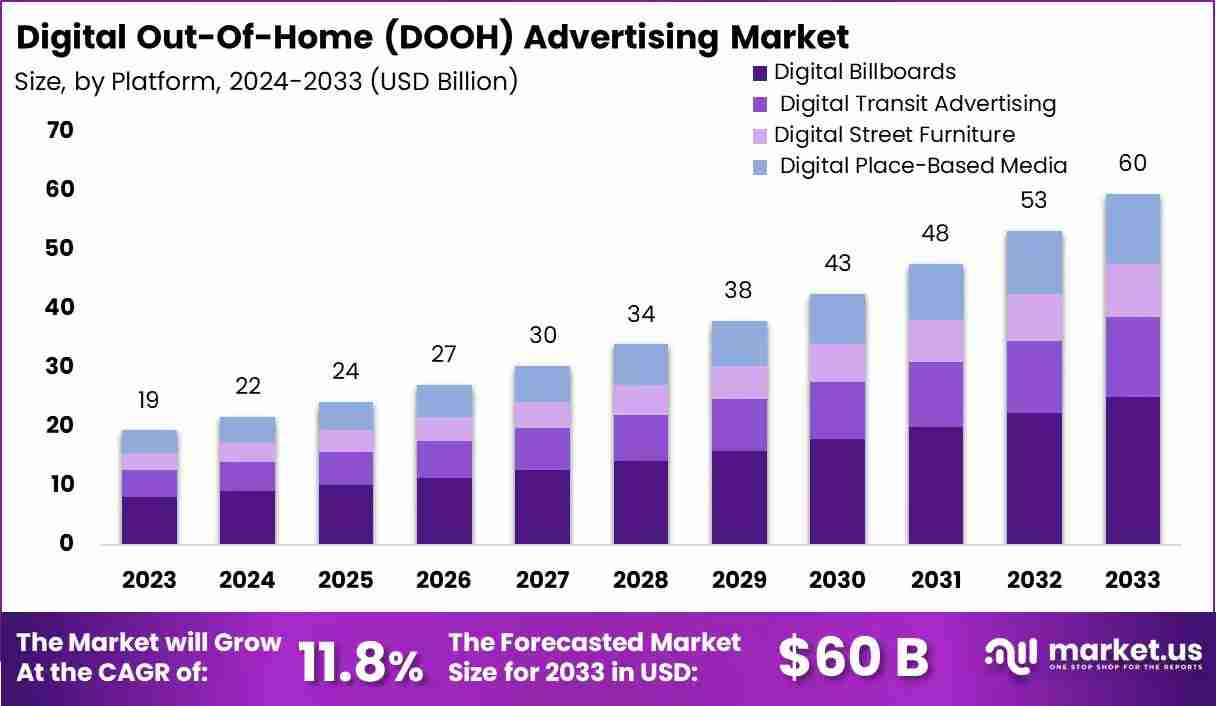
Urban environments are becoming digitally connected ecosystems where information, services, and communication flow through intelligent infrastructure. Within this transformation, the Digital Out-Of-Home Advertising Market is benefiting significantly from smart city initiatives and advanced display technologies. Digital screens embedded in transport hubs, streets, commercial zones, and public utilities are no longer just advertising assets; they are part of urban communication networks. This convergence of technology and infrastructure is accelerating DOOH adoption globally through 2033.
Explore how data-backed metrics and analytics are improving performance in the Digital Out-Of-Home Advertising Market at: https://market.us/report/digital-out-of-home-dooh-advertising-market/.
Smart city projects prioritize connectivity, real-time information sharing, and digital engagement. As municipalities deploy digital kiosks, wayfinding panels, and interactive displays, they create natural expansion points for the DOOH Advertising Market. These installations serve public communication needs while offering premium advertising inventory for brands.
Internet of Things (IoT) technology enables digital screens to connect with centralized networks for remote content management. This connectivity strengthens the operational efficiency of the Digital Out-Of-Home Advertising Market, allowing advertisers to update content across multiple locations instantly.
Explore how data-backed metrics and analytics are improving performance in the Digital Out-Of-Home Advertising Market at: https://market.us/report/digital-out-of-home-dooh-advertising-market/.
Smart city projects prioritize connectivity, real-time information sharing, and digital engagement. As municipalities deploy digital kiosks, wayfinding panels, and interactive displays, they create natural expansion points for the DOOH Advertising Market. These installations serve public communication needs while offering premium advertising inventory for brands.
Internet of Things (IoT) technology enables digital screens to connect with centralized networks for remote content management. This connectivity strengthens the operational efficiency of the Digital Out-Of-Home Advertising Market, allowing advertisers to update content across multiple locations instantly.
Urban environments are becoming digitally connected ecosystems where information, services, and communication flow through intelligent infrastructure. Within this transformation, the Digital Out-Of-Home Advertising Market is benefiting significantly from smart city initiatives and advanced display technologies. Digital screens embedded in transport hubs, streets, commercial zones, and public utilities are no longer just advertising assets; they are part of urban communication networks. This convergence of technology and infrastructure is accelerating DOOH adoption globally through 2033. Explore how data-backed metrics and analytics are improving performance in the Digital Out-Of-Home Advertising Market at: https://market.us/report/digital-out-of-home-dooh-advertising-market/. Smart city projects prioritize connectivity, real-time information sharing, and digital engagement. As municipalities deploy digital kiosks, wayfinding panels, and interactive displays, they create natural expansion points for the DOOH Advertising Market. These installations serve public communication needs while offering premium advertising inventory for brands. Internet of Things (IoT) technology enables digital screens to connect with centralized networks for remote content management. This connectivity strengthens the operational efficiency of the Digital Out-Of-Home Advertising Market, allowing advertisers to update content across multiple locations instantly.
0 Comments
0 Shares
8 Views
0 Reviews

 Arabic
 French
 Spanish
 Portuguese
 Deutsch
 Turkish
 Dutch
Dutch
 Italiano
 Russian
 Romaian
 Portuguese (Brazil)
 Greek
Greek